

You are trying to decide whether to keep paying for SEO.
Your traffic charts look strange. Someone on LinkedIn told you SEO is dead and the budget belongs in GEO now. Someone else told you that person sells a GEO tool. Both sounded completely certain. Neither of them showed you a single thing they had gotten wrong.
That is the problem with writing about the future of SEO. Predictions are free to make, and almost nobody comes back to check their own.
So I am coming back to check. I am a SaaS copywriter who spends most of my time on SEO blog posts and landing pages. I have a professional stake in getting this right. You can decide for yourself whether my track record has earned the next two years of your attention.
I published this post in June 2024 and made six predictions about 2025. Two years later, I am grading my own homework in public.
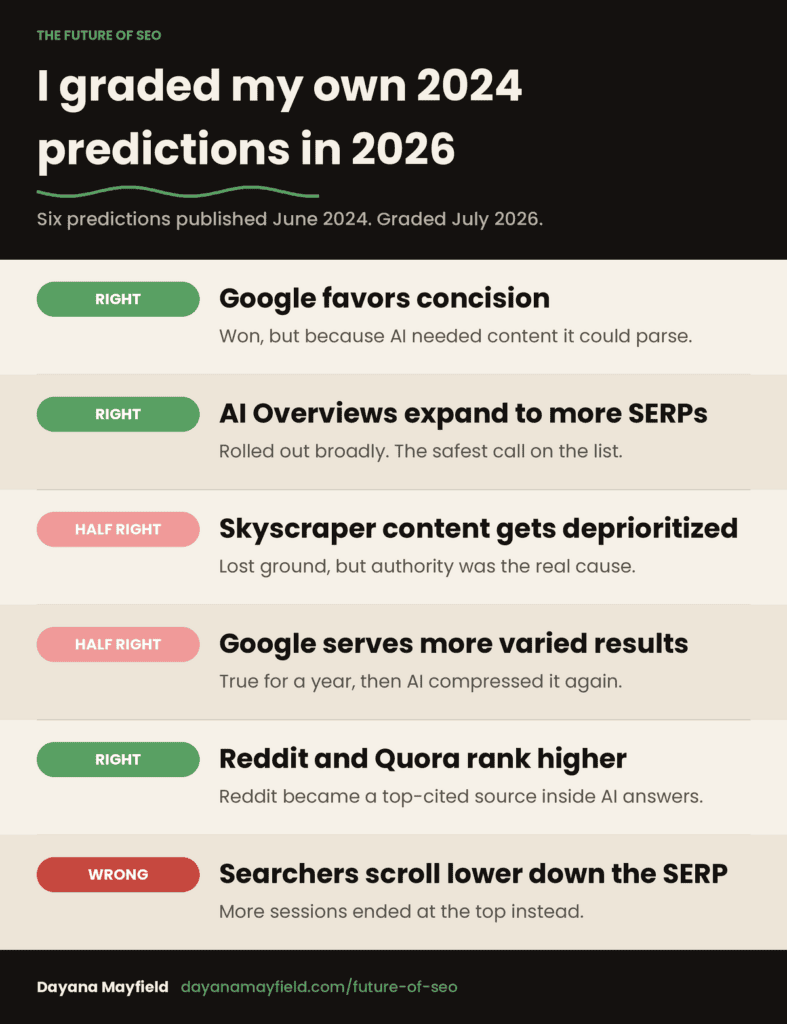
All six have resolved. Three I would call right. Two were half right, for reasons more interesting than the predictions themselves. One I got wrong enough that I spent this spring telling clients to do the opposite.
Then there is the thing I missed completely. It was not a prediction at all. It was the ground moving under the whole exercise.
Here is the clearest sign of that shift. Pew Research Center (2025) tracked what people actually did next. Users who saw an AI summary clicked a traditional search result in 8% of visits. Without an AI summary, that figure was 15%.
Roughly half the clicks, gone, on the queries where AI shows up. No amount of better blog post fixes that.
What follows is the scorecard, the shift I missed, and the advice from 2024 that still stands. Seven of my nine original tips needed no changes at all, which surprised me more than any of the predictions did.
The six predictions I made for 2025
These six made the cut in 2024 for one reason. Each carried a claim specific enough to be proved wrong later. I left out the vague ones, the ones that could be spun either way after the fact, because those are worthless to grade.
Verdicts run right, half right, or wrong. The original predictions below are untouched.
Concision won, but not the way I expected
With AI having the power to generate all sorts of text for us, we'll no longer need ridiculously long blog posts. For many keyphrases, under 2000 words will do. The game will become fitting more dense information in smaller wordcounts instead of being verbose.
Right, with a caveat that changes what you do about it. Concision won. The pressure came from AI systems needing content they can parse and lift cleanly, not from readers asking for shorter posts. Optimize for density, not for brevity.
AI Overviews got better and went nearly everywhere
There are lots of news stories about how Google's AI Overview gave hilariously inaccurate information. In the near future, we can expect Google to improve this feature, roll it out to more users, and include it on more search engine results pages.
Right, and boring. This was the safest call on the list. The interesting question moved somewhere else entirely: not whether AI answers appear, but which queries trigger them and whose content gets cited inside.
Skyscraper content lost, slowly
Brian Dean of Backlinko popularized the skyscraper method, where you write a ton of H2s and H3s to cover every subtopic under the sun in your blog post.
At the time I pointed to a drop in Backlinko's traffic as early evidence that the method had started to backfire.
Half right. Skyscraper posts did lose ground, but length was never really the problem. Authority was. Thin comprehensive guides fell because the sites publishing them had nothing behind them, and that took longer to play out than I predicted.
Result variety improved, then AI flattened it again
In the past, professional SEOs would just try to copy or one-up what was on the SERPs. But in the future, Google will continue to do a better job of giving a variety of results, some listicles, some guides, some contrarian view points, etc. So, the game shouldn't be to copy top rankings, but instead to provide alternate viewpoints and information for Google to surface for users.
Half right, and the most interesting grade on this page. For about a year, Google did serve more varied formats. Then AI Overviews compressed a lot of those results back into one synthesized answer. Variety did not disappear. It moved off the SERP and into the list of sources cited inside the answer.
Reddit rose further than I predicted
Google is all about serving the end user. Instead of forcing people to type "Reddit" or "Quora" at the end of their search queries, Google now ranks forum results at the top or middle of the page for the vast majority of searches. You can expect to see more of this in 2025, because Google is committed to giving searchers what they want.
Right, and then some. Forum results kept climbing, which is what I said would happen. Where they ended up is the part I did not see.
Pew Research Center (2025) found that Wikipedia, YouTube, and Reddit are the most frequently linked sources in AI summaries and standard results alike. Together they accounted for about 15% of the sources listed in the AI summaries examined.
I called the Reddit rise correctly. I did not expect it to end up as one of the three sources AI systems lean on most.
So a thread you did not write, cannot edit, and may not know exists is helping shape how AI describes your category.
Scrolling behavior changed less than I thought
It used to be that the top spot got all the traffic. That probably won't be the case in the future. With Google giving more varied results (instead of different companies' versions of the same comprehensive guide), users will have more reasons to review the entire SERP before choosing what to click on. And if someone is looking for a solution or service, they'll ignore the AI Overview response and keep scrolling. Of course, getting on page 1 is still essential.
Wrong. I assumed people would work their way down more of the page before clicking. More sessions ended at the top of it instead, inside the answer. The mechanism ran opposite to what I described.
The shift I did not see coming: SEO became the input layer for AI answers
Every one of those six predictions asked the same underlying question. How will Google rank pages?
Two years later, that question is too small. Your content is no longer only a thing that ranks. It has become source material for what AI systems say about you when your buyer goes looking.
Your own pages still decide what AI says about you
Ask ChatGPT to compare your product against two competitors. Whatever comes back was assembled partly out of your own website.
That answers the budget question you arrived with. Moving SEO money into generative engine optimization treats them as separate channels when they draw from the same well. Your blog posts and landing pages are the raw material. Vague positioning on your own site produces an even vaguer AI summary of your company, and you will never watch it happen.
Aggarwal et al. (2024), published at ACM SIGKDD, tested what makes a source get cited. Adding citations, quotations from relevant sources, and statistics boosted visibility in generative engine responses by over 40%.
I want to be careful with that number, because it gets quoted loosely by people selling things. It measures relative visibility inside a controlled test where the documents were already in front of the model. Treat it as evidence that structure affects citation. Do not treat it as a promised 40% lift.
What other people say about you now counts too
Your website is necessary. It stopped being sufficient.
AI systems assemble answers from whatever they can reach. The listicle you are not on. The comparison page a competitor wrote. The review site, the Reddit thread, the podcast you turned down. All of it feeds the same response your homepage feeds. Look again at the Reddit grade above. That was the early signal, and I read it as a SERP story when it was really a citation story.
Forrester (2025) reported that 94% of business buyers now use AI somewhere in their buying process. Generative AI and conversational search were named a more meaningful information source than anything else, by twice as many buyers.
One SaaS client came to me with strong Google rankings and almost no presence in AI answers. We audited 15 bottom-of-funnel prompts and their brand surfaced in two of them. The fix was not more blog posts. It was getting them named in the third-party roundups and comparison pages the models were already pulling from.
Now the part nobody selling AI search optimization will tell you. Plenty of what gets marketed as GEO right now is standard SEO advice wearing a new label. Some of it will quietly damage your search performance. Here is the filter I use. If a tactic would still be a good idea in a world where ChatGPT did not exist, it is probably real. If it only makes sense as a way to game a model, skip it.
In 11 years and 196 clients, I have never watched a channel change this fast. The content strategy work I do now looks less like a keyword plan and more like a reputation plan.
What to do about the future of SEO now
The advice section aged better than the predictions did. Seven of these nine still stand exactly as written in 2024, which I honestly did not expect. Two needed correcting, and one of those is the biggest miss on this page.
1. Stop copying everybody else
Study the SERP more than your boss's briefs (sorry, boss).
Many content managers are using outdated best practices. They take a look at the SERP and build briefs that essentially copy what other people are doing.
That's not going to keep working.
Google wants to give users a few different options, not slightly rehashed versions of the exact same article on different websites.
For example, if I search "small business advice," I see government websites, a list of tips, a mentoring foundation, a list of free resources, and a step-by-step guide to starting a small business. The first several results are all completely different.
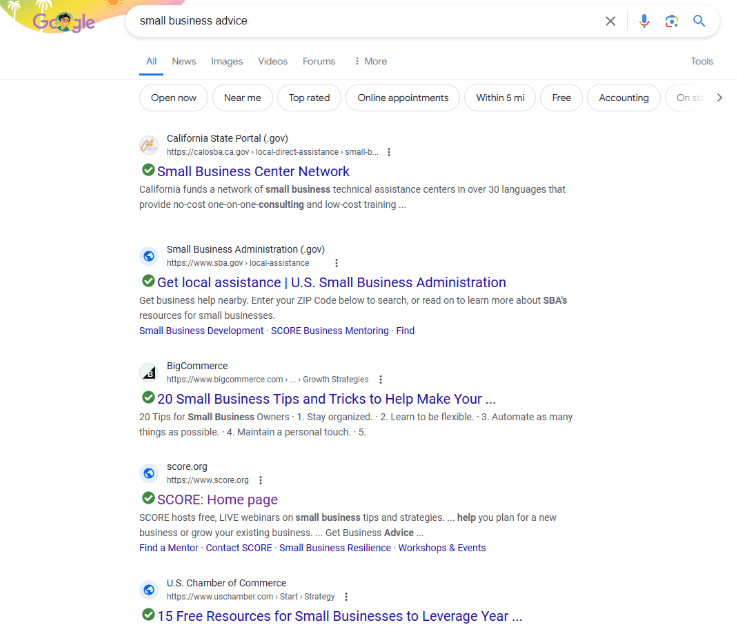
Google is getting better and better at switching up the search results for all sorts of keyphrases, so don't be afraid to zig where others zag. In fact, you'll like get better results.
2. Test more content formats
When in doubt, uplevel your formatting.
For one of my clients, I've come up with a new formatting style that is not only easier to write than an in-depth list of 25 tools with features, pros, cons, and pricing, but is also ranking higher.
This has allowed us to secure rankings for very high-volume, high-competition keyphrases related to widgets, tools, software, etc.
I'm not going to give away the format here, because I don't want other SEO professionals to start copying it. (Just fill out my contact form if you want to work with me and see some of my samples.)
But I will say this: if you're struggling to boost your overall rankings, try to format things better. Use more subheadings, bold text, bullet points, etc.
As for the point above, try your own formatting experiments instead of just copying the way that other sites are using H3s and bold text.
3. Take more at-bats (the call I got wrong)
This is the one I got wrong. I told you to publish more, and by early 2026 I was helping clients delete posts instead.
The original advice here was volume. Take more swings, buy more lottery tickets, let sheer output do the work. That logic held while authority was a bonus. Once authority became a prerequisite, every thin page started costing you rather than buying you another chance. Underperforming posts now drag down the site they sit on. I ended up telling clients to delete posts instead, and the pruning outperformed the publishing.
What still holds is the humility underneath the tip.
The truth is that we SEO content writers love to come up with best practices. But Google, the fickle mistress we're all pining for, doesn't care. She doesn't rank our articles just because we follow best practices. She ranks what she wants when she wants.
For example, I just tried some software searches and here's what I found as of the time of writing on June 6, 2024:
- CRM software – The top result is a guide. What is CRM Software? A Comprehensive Guide and Historical Overview of CRM by Salesforce.
- email marketing software – The top result is a listicle with 11 items. The Best Email Marketing Software for 2024 by PCMag.
- business travel software – The top result is an overview of listings with real user ratings. Best Corporate Travel Management Software Reviews 2024 on Gartner.
All of these searches end in "software" but the winning results are completely different formats.
So how can SEOs tell you to do the same thing for every article? How can they say they know what works? They don't know. They're just pulling your teeth.
So here is the corrected tip. Take your swings where you have a real shot. Fewer pages, more depth on each, aimed at the queries where your actual experience changes the answer.
4. Speed up your publishing process
Speed still matters. Point it at updates. A refresh that ships this month usually beats a new post that ships next quarter.
Improving your internal processes is one of the best things you can do to compete in the future of SEO.
You can use a platform like StoryChief (my favorite) or CoSchedule to bring briefing, writing, reviewing, and publishing under one roof.
Or, empower your internal content managers to publish more. Some founders and marketing leaders are so meticulous that they want to read and review each and every article. I guarantee this is crushing your potential. Make a style guide, clarify the no-no's, and get out of the way so your team can publish more content faster.
5. Share your unique take
Because Google is doing an increasingly better job of surfacing different formats and types of results, you need to give Google something fresh.
Share your unique perspective, using these strategies:
- Proprietary data
- Customer stories
- Quotes
- In-house expertise
Don't just add snippets to your article, but allow your unique perspective to shape the outline.
If you don't have the time or budget to source quotes from your internal team or customers, hop over to YouTube. Watch a video on the topic, transcribe the best parts, and quote the speaker, linking back to their YouTube video and website. Now you've got something fresh and insightful to add to your article.
6. Stuff subtopics, not keywords
The more subtopics and related topics you can cover in a single paragraph, the better. People don't want to scroll through lengthy content, but they still want all of the information.
In the future of SEO, concision wins. Professional copywriters have already been playing this game for decades. When writing ads, we stuff benefits and campaign terms into 30 characters.
Now it's time for SEO writers to condense their research and advice into fewer words.
Stuff those paragraphs full of rich, relevant subtopics so Google gets all of the details it wants and readers aren't aggravated by too much scrolling.
7. Add more details, not just statistics
Remember how I said SEOs are full of crap when they pretend to know what works? Not every article needs to start with a statistic. Not every article even needs a statistic anywhere.
But every article does need details.
Here are some ideas:
- The historical context
- More descriptive language
- Examples
- Lists
- Resources
- Analogies and metaphors
- Humor
- Infographics
- Embedded videos
- Anecdotes
8. Don't be afraid to use different points of view
You know what's funny about SEO?
The word you.
That's known as writing in second person, and nowhere else in the world do we see the second-person point of view as much as we do in SEO.
Do you want to grow your business? To grow your business, you need to…
Almost every blog post is written this way, and beyond tiresome.
Sure, most companies will still write using second-person perspective, but in the future of SEO, as Google continues to surface more varied results, we'll need other perspectives too.
Journalists do this well. Celebrity interviews, for example, usually feature "I" and "she" statements.
Here's an example I just whipped up:
I was so nervous to meet the queen of rock and roll, my armpit stains were big enough to swim in. But the moment she sat down, her smudged eye makeup made me feel okay with being human.
I believe that in the future of SEO, we'll have more freedom to write using other perspectives, because Google wants variation.
9. Write better hooks
We know that pages that don't perform well will start to lose their rankings. To have a chance at securing new rankings, and to hold the ones we've got, we need to really hook people in. Most people won't read the whole 2000-word article, but they'll read the first 100 words.
So take your time to make your hooks as interesting as possible.
The bottom line on the future of SEO
Three right, two half right, one wrong, and one shift I missed entirely. That is an ordinary scorecard. It is also more than most people writing about the future of SEO will ever put in front of you.
If you keep one line from this page, keep this one. Your content stopped being the destination and became the input. It feeds Google, it feeds the models, and it shapes what strangers say about you in the places those models read.

Want a system for that rather than a vibe? I keep a Content Authority Tracker template that centralizes expert profiles, customer stories, proprietary data, and quotes. Click File, then Make a copy, and it is yours.
I will be back here in mid-2028 to grade this set. Same page, same rules.
Learn more about my copywriting services here.
Future of SEO FAQs
Is SEO dead in 2026?
No, and the people saying so usually have something to sell you. Google still handles the large majority of search, and AI systems build their answers partly from pages that rank. What died is the version of SEO where a well-optimized post on an unknown site could win on merit alone. Authority comes first now, and content follows behind it.
Should I move my SEO budget to GEO?
Not as a straight swap. Your blog posts and landing pages are the raw material AI systems use to describe you. Cutting SEO to fund GEO starves the thing you are trying to feed. Shift some budget toward offsite work instead. Digital PR, listicle placements, expert commentary, and LinkedIn all move the needle, while your on-site content keeps earning citations.
Will SEO still exist in five years?
Almost certainly, though the job title may not survive intact. Somebody will still have to decide what a company publishes, who it gets attributed to, and where it shows up beyond its own domain. That work looks closer to reputation strategy than to keyword research now. Call it whatever you want in 2031.