

If you think SEO in 2026 is still about who can write the “best” blog post, you’re already behind.
That’s not because quality doesn’t matter—it absolutely does. But quality alone is no longer the differentiator. And, if we’re being honest, it hasn’t been for a while.
The real question Google is asking now isn’t:
Is this a good article?
It’s this:
Does this site deserve to be here at all?
And that’s a much harder game to play.
The shift: from content quality to content authority
For years, smaller players had a real shot at ranking.
You could publish a well-optimized, well-written, comprehensive article, hit the right subtopics, include your keywords, and still land on page one—even if your brand wasn’t widely recognized.
That era is fading.
What’s replacing it is something far less forgiving: authority as a prerequisite, not a bonus.
Google is increasingly evaluating signals like:
- Who is publishing this?
- Are they known in this space?
- Do they have a track record beyond their blog?
- Do real people engage with them outside of search?
In other words, SEO is no longer just an editorial exercise. It’s a reputation-driven system.
And the websites that are still performing well?
They aren’t just publishing content.
They’re present everywhere.
What I’m seeing across sites that didnt get dinged
As a SaaS SEO content strategist, I dug deep into this update and reviewed its effects across a dozen websites.
The sites I manage that weren’t negatively impacted by recent updates all share one key trait:
They are clearly established players within their niche.
Not “somewhat known.” Not “up-and-coming.” These are the companies that people in the industry would immediately recognize.
And when you look closer, their resilience makes sense.
They are consistently...
- Investing in digital PR
- Publishing on social media
- Appearing on podcasts
- Hosting or participating in webinars
- Collaborating with other brands
Their content doesn’t exist in isolation.
It is supported by a broader ecosystem that reinforces one core signal: this company knows what it’s talking about.
Now compare that to a site that has relied almost entirely on SEO content.
The gap becomes very clear.
Why content that satisfies the query isn't enough anymore
Here’s the uncomfortable reality.
There is more “good content” on the internet than Google knows what to do with.
AI has accelerated this dramatically.
SEO content writers today are more efficient. Frameworks are more refined. And most marketers now understand how to produce a solid, readable, SEO-friendly article.
So Google has had to evolve how it filters results.
Instead of asking, “Which article explains this best?” it’s now asking:
- Which perspective is worth showing?
- Which site has earned visibility?
- Which brand has real-world credibility?
This shift aligns with what we’ve already been seeing in search results. As Google continues to expand AI-generated overviews and reduce available organic real estate, it is prioritizing content that contributes something new—rather than repeating the same structure over and over.
And this is exactly where smaller players struggle.
The post-March-2026 reality for smaller sites
A few years ago, you could build an entire growth strategy around SEO.
You could publish consistently, follow best practices, build links, and gradually gain traction.
Now, if SEO is your only channel, you are at a significant disadvantage.
Because you are no longer just competing on content—you are competing on presence.
Smaller sites have to compensate for a lack of brand authority by building it elsewhere:
- Community
- Visibility
- Partnerships
- Original insights
Without these elements, your content has to work significantly harder just to be considered—and even then, it may not be enough.
The overlooked pattern: SEO-only sites vs. real brands
There’s another pattern that’s hard to ignore.
The sites that were hit the hardest tend to have the same characteristics:
- SEO-only strategies
- Heavy reliance on blog content
- No meaningful social presence
- No PR or partnerships
- No lead-generating assets or research
In contrast, the sites that remained stable—or even improved—have diversified their marketing efforts.
They are building visibility across multiple channels, not just search.
This isn’t a coincidence.
It reflects a deeper shift in how Google evaluates authority.
Why other marketing channels now influence SEO
It’s not that Google is directly measuring your podcast appearances or LinkedIn posts in a simple, trackable way.
It’s that these efforts create secondary signals that are much harder to fake—and much more meaningful.
For example:
- Branded search demand increases when people recognize your company and actively look for it.
- Natural mentions and backlinks grow when you publish research, collaborate with partners, or earn media coverage.
- Topical authority becomes more credible when it’s validated outside of your own website.
- Engagement signals improve when your content is part of an ecosystem rather than a standalone asset.
Individually, these may seem indirect. Collectively, they paint a very clear picture of legitimacy.
Free Content Authority Tracker Template: The system I'm using
If this all sounds good in theory but overwhelming in practice—you’re not wrong.
You’re suddenly managing expert profiles, case studies, proprietary data, quotes, and assets… and without a system, it falls apart fast.
So I built one.
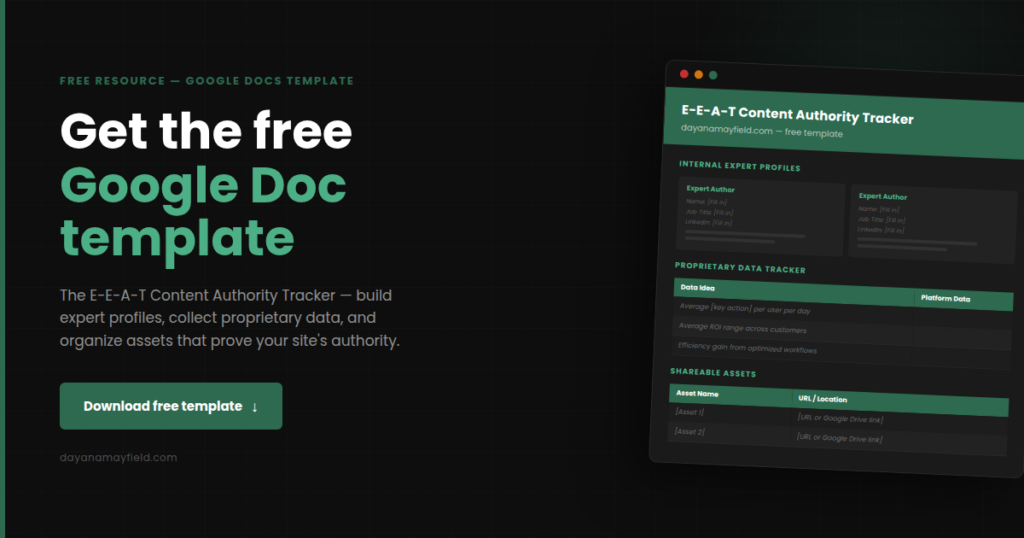
It’s a simple working document I use to centralize everything tied to E-E-A-T and content authority. It helps you:
- Assign real experts to content
- Track case studies and insights
- Collect quotes from your team
- Organize proprietary data
- Manage shareable assets
The goal isn’t more content. It’s better inputs.
Because authority isn’t built randomly—it’s built systematically.
What should you do about the March 2026 Google update?
This is where strategy matters most.
Because “build authority” sounds nice—but without execution, it doesn’t mean much.
Here’s the approach I’m using.
1. Cut what isn’t pulling its weight
Start with a realistic audit.
If a piece of content isn’t generating more than 10 clicks over a three-month period, it’s not contributing meaningfully.
At best, it’s neutral. At worst, it’s diluting your overall site quality and spreading your authority too thin across too many weak pages.
The solution:
- Merge overlapping content into stronger, more comprehensive pages
- Prune low-value or outdated posts that no longer serve a purpose
- Redirect underperforming URLs to the most relevant, higher-quality pages
As you do this, look for patterns. Are there clusters of content targeting slight keyword variations? Are multiple posts competing for the same intent? That’s usually where the biggest wins are.
2. Stop publishing content that could be written by anyone
A lot of blog posts look polished but say nothing new.
They follow predictable structures—definitions, benefits, steps, tools—and while they’re readable, they’re also interchangeable. You could swap out the logo at the top and it would still make sense.
That’s the problem.
In today’s SEO landscape, generic content is easy to produce—and just as easy to ignore.
If your article could be written by someone with no real experience in your space, it’s probably not strong enough to compete.
So instead of asking, “Did we cover everything?” ask:
Did we add anything meaningful? Good copywriting should be specific.
That could mean:
- Taking a clear stance instead of staying neutral
- Challenging common advice in your industry
- Sharing what actually works based on real experience
- Including nuances that only insiders would know
The goal is distinctiveness.
3. Go all-in on proprietary inputs
If you want to compete without massive brand authority, you need leverage.
That leverage comes from inputs that cannot be easily replicated:
- Expert quotes
- Customer examples
- Case studies
- Proprietary data
- Internal insights
These elements do more than “enhance” a post—they make it defensible.
Anyone can summarize existing information. Very few can add something original.
To make this practical:
- Build a simple system for collecting internal insights (Slack threads, forms, quick interviews)
- Turn customer conversations into mini case studies
- Document patterns you’re seeing across clients or campaigns
- Pull data from your product, CRM, or internal reporting
And most importantly, don’t tack these on at the end.
Use them to shape the angle, structure, and argument of the piece from the start.
4. Prioritize updating over publishing
It’s easy to default to creating new content because it feels productive.
There’s a clear output. A new URL. Something to point to.
But right now, updates often deliver stronger—and faster—returns.
Instead of constantly chasing new topics, look at what’s already ranking (or close to ranking) and improve it.
Take existing posts and:
- Add new examples that reflect current realities
- Incorporate expert insights or quotes
- Include fresh or proprietary data
- Strengthen your point of view and clarity
You can also revisit structure:
- Tighten sections that feel bloated
- Improve formatting for readability
- Update intros and hooks to better match search intent
You’re not just refreshing content—you’re upgrading it into something more authoritative, more useful, and more aligned with what Google is looking for now.
5. Be intentional with new content
When you do publish new content, it needs to be strategic.
Top-of-funnel topics are becoming increasingly difficult to win. They’re crowded, heavily influenced by AI overviews, and dominated by brands with strong authority signals.
That doesn’t mean you should ignore them completely—but you should be selective.
Instead, prioritize bottom-of-funnel content where:
- Search intent is clearer and more action-driven
- Competition is narrower and more specific
- Your expertise can actually influence a decision
Focus on:
- High-intent queries
- Real use cases and scenarios
- Clear buyer relevance
- Content gaps your competitors haven’t addressed
And as always, incorporate original insights.
Even highly targeted content can fall flat if it feels generic.
The goal is to create pages that don’t just answer a question—but help someone move closer to a decision.
6. Match content to real authors (not just a brand name)
There’s one more lever that’s becoming increasingly important—and it’s one of the fastest wins if you implement it properly.
Who is actually writing your content?
Not in a vague, “this was written by the marketing team” sense. But in a clear, specific, attributable way that ties expertise directly to the topic.
Because if Google is evaluating who deserves to rank, then authorship matters.
A generic author profile doesn’t build trust. A real expert does.
That means moving away from:
- Placeholder author names
- Generic bios written by marketers
- One person writing everything regardless of subject matter
And moving toward a model where content is attributed to internal experts with relevant experience.
For example, instead of having one writer cover SaaS, field sales, and political canvassing, you align each topic with someone who actually works in that domain.
This isn’t just a branding exercise. It directly supports authority.
Strong author profiles should include:
- Real roles and titles within the company
- Years of experience
- Areas of expertise (tied to content categories)
- A consistent body of work on related topics
- Supporting signals like LinkedIn profiles or public presence
And the content itself should reflect that expertise—not just in tone, but in substance.
One way to operationalize this is by building internal expert profiles and then structuring your content around them. Identify 2–6 subject matter experts across your key categories, define what each person owns, and consistently attribute content accordingly. fileciteturn1file0
From there, you can take it a step further.
Interview each expert. Capture their experiences, opinions, and frameworks. Use that to inform the content—not just at a surface level, but in how the article is structured and what it prioritizes.
If you’re using AI to support writing, this becomes even more powerful. You can build dedicated workflows or models around each expert’s voice, insights, and perspective—so the output still feels grounded in real experience rather than generic content patterns.
The goal isn’t to “fake” expertise.
It’s to surface the expertise that already exists inside your company—and make it visible, consistent, and aligned with your content strategy.
7. Build authority beyond SEO
This is no longer optional.
If Google is evaluating who deserves visibility, then your presence outside of search becomes critical.
That includes:
- Consistent LinkedIn publishing
- Podcast appearances
- Webinars and speaking opportunities
- Brand partnerships
- Digital PR
These efforts shape perception—and perception influences rankings.
The bottom line
SEO isn’t disappearing.
But the version of SEO where you could publish great content in isolation and expect results is fading.
What’s replacing it is more demanding—but also more aligned with how real businesses operate.
The brands that succeed are the ones that:
- Show up consistently
- Contribute original insights
- Build authority across multiple channels
Not just on their blog, but everywhere.
So if your strategy still revolves around publishing more content, it may be time to redefine what “more” actually means.
Because in 2026 and beyond, it’s not about breadth.
It’s about depth.
And whether you’ve earned the right to be heard.
Learn more about my copywriting services here.